Wild Pears
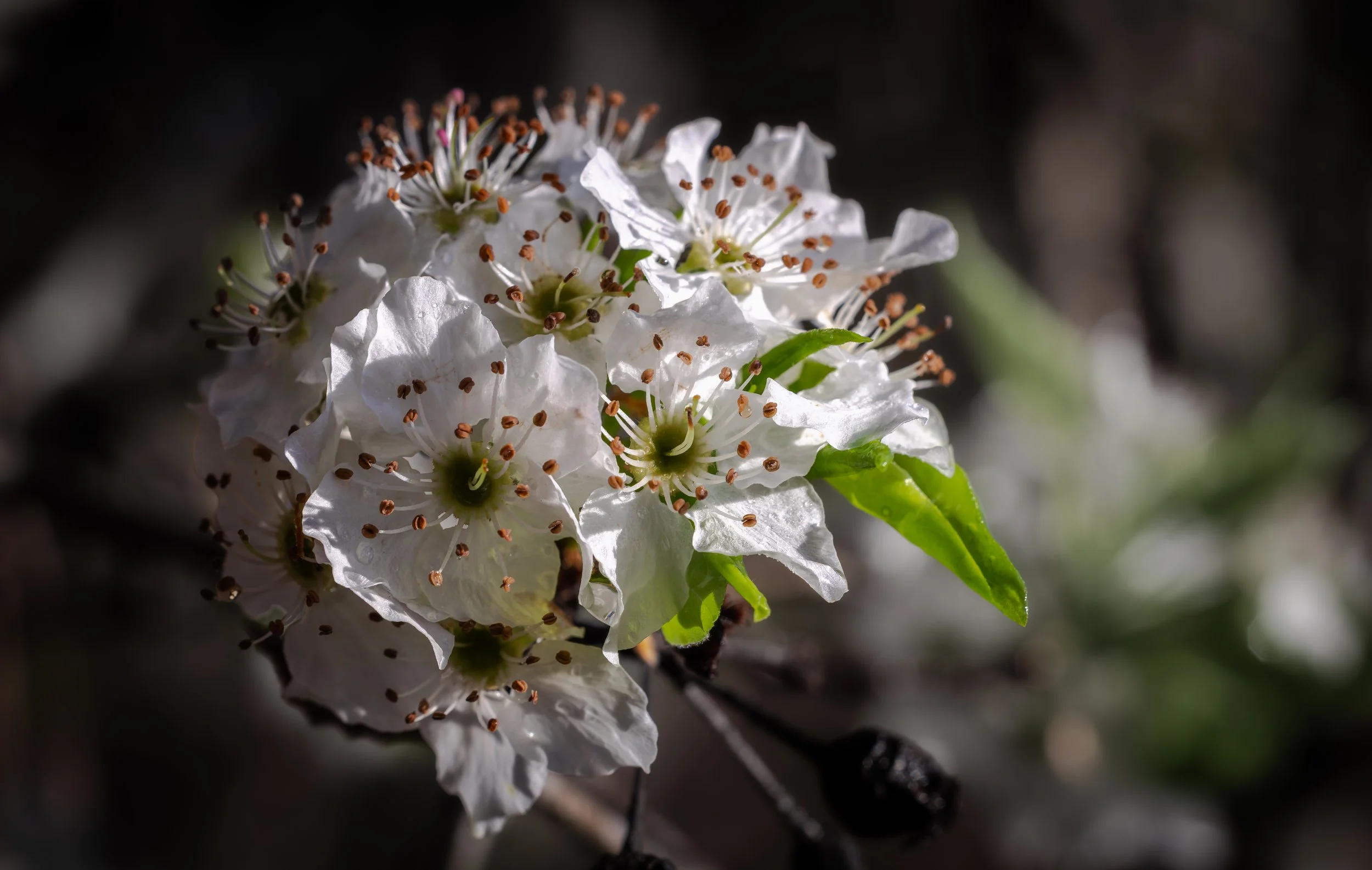
In the earliest days of spring, after the green stalks of wild daffodils have emerged from the frosted earth, the beauty of a single tree species arrests the North Carolinian landscape. The wild pear trees provide visual confirmation that winter has drawn to a close. But many detest this tree as an abomination of nature.
Its beauty is undeniable. It is large, symmetrical, and the entire tree flowers all at once, with white blossoms blazing bright, and thousands of flowers that glisten in the spring sun. Every branch is heavy and full with corymb-like clusters of blossoms, each small flower with its five white petals and delicate pink anthers. But the deceptive blooms bring something people loathe; they emit a putrid odor described by many as the detestable stench of rotting fish. These unassuming flowers release a chemical cocktail, including trimethylamine and several other foul-smelling substances. The result, a smell that attracts pollinators, but betrays the tree’s beauty enough to make it a certified nuisance.
And then, a contradiction. This tree, so disliked, is everywhere. Whether in abandoned pine groves, along rural farm roads, in the yards of country homes, or navigating through residential communities, the beautiful white blooms and the foul odor they carry are all around.
But living with the wild pear tree isn’t a stroke of bad luck. Two hundred years ago, the tree didn’t even exist on our continent. The story of how it got here and why these trees dominate the local landscape offers insight into what happens when the human desire to control falls short of nature’s ability to survive.
In the late 1800s, pear orchards in the United States faced a horrible affliction that was killing off the local fruit trees. This was fire blight, a destructive bacterial disease that left the branches of pear and apple trees looking burned and brown. To rescue the fruit tree industry, agriculturists searched the world over for a remedy, finally discovering the Callery pear tree, indigenous to China and Vietnam. This tree was hardy, able to survive in conditions that killed other trees, resistant to both floods and drought. There was only one problem: the tree did not produce edible fruit.
Agriculturists brought Callery pears to the United States by the tens of thousands in order to harvest their seeds, which were planted and grown in American orchards. Then, as if out of the pages of Frankenstein, the trees’ limbs were severed and replaced, through grafting, with the branches of other trees that produced edible fruits. Using the Callery pear trees as rootstock made the orchards impervious to fire blight, allowing the pear industry to recover.
Because the Callery pear tree had not undergone the region’s normal evolutionary process, there were few enemies in its newfound home. There were no local animals, birds, insects, or diseases which had adapted to cull the tree. This resistance became both the solution to fire blight and the cause of an ecological blow that would take half a century to unfold.
The new trees were beloved by the people. Their beautiful white blooms in spring and red leaves in fall resulted in creating a hybrid now known as the Bradford pear tree. Scientists carefully engineered the Bradford to be sterile to prevent the tree from taking over the land. This beautiful and fast-growing tree soon appeared in urban and rural yards everywhere. People used them for landscaping around apartment lots, shops, and buildings.
Everything was going well. And then, as the saying goes, life finds a way. People planted Bradford pears everywhere, and nature produced natural hybrids that ended up cross-pollinating the once sterile trees. Birds ate and passed seeds to fertile grounds, and bees carried the flowers’ pollen, as did the warming spring winds. At some point, a hyper-resistant hybrid was born.
The new tree was wild and unmanageable. With no evolved resistance to local diseases or predators, it quickly flourished. The invasive tree was still beautiful, but nature had chosen attributes meant to serve the tree and not the people who lived with it. Butterflies and bees found the flowers’ scent appealing, but to humans, the odor they produced was awful. The tree also grew long, terrible thorns, strong enough to puncture thick tractor tires, creating a nuisance for farmers. And because the tree grew quickly and bloomed earlier in spring, it dominated the woodland canopies, taking over the sunlight needed by the native trees.
Local insects and birds did not use the tree for food or nesting. And because the native trees that attracted wildlife were dying out, the lowest rungs on the food chain declined, creating a domino effect that robbed the forest of much-needed resources. Even whitetail deer, known as hardy foragers, disliked the taste of the wild pear trees, preferring to forage on the native trees that remained, leading to further decimation of the natural landscape.
I still love the beautiful spring blooms of the wild pear trees, and the scent they give off doesn’t bother me. But rather than a promise of spring’s renewal, they remind me of what happens when human beings are smart enough to meddle with nature’s natural processes, but too shortsighted and apathetic to consider the long-term consequences of our actions. In solving an agricultural problem, we permanently scarred entire regions of our native lands, effectively knocking local ecosystems out of their natural balance with the minor act of planting a few seeds that did not belong.